Choosing an SPD Electrical Protector is not a matter of picking the largest number on a product label. Global buyers must match the device to the site’s voltage, grounding arrangement, exposure to lightning, and equipment sensitivity. A protector suited to a factory panel may not fit a small commercial building. Even a strong model can be the wrong fit.
Dr. Peter Hasse, a recognized surge-protection specialist and author, has emphasized coordinated protection in his published work. A concise paraphrase of that principle is: “A surge protective device works best when coordinated with the electrical system.” This is a paraphrase, not a verbatim quotation. It points to a practical lesson: check the protection level, maximum continuous operating voltage, discharge ratings, and installation requirements together. Details matter.
This guide compares seven SPD options for buyers serving different regions and applications. It considers Type 1, Type 2, and combined devices, along with status indicators, replaceable modules, enclosure ratings, and available conformity documentation. These details help narrow the shortlist, but they do not replace a qualified site assessment. Standards and approval requirements can vary by destination market. Product specifications can also differ between model variants, so confirm the exact datasheet before ordering. A comparison can make the decision clearer, though it cannot make every trade-off disappear.
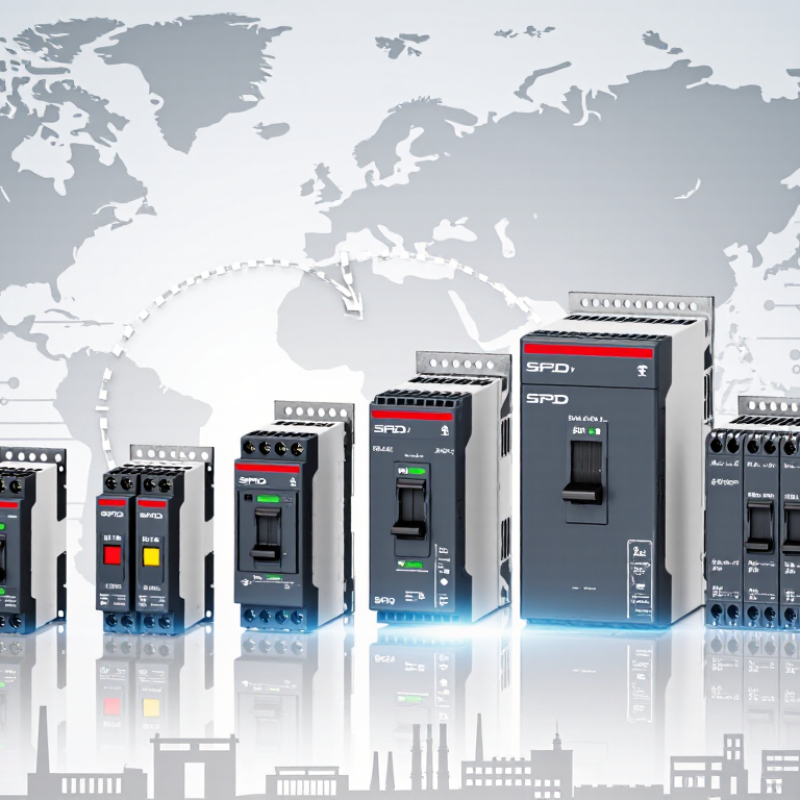
A surge protective device (SPD) limits brief overvoltage by diverting surge current and reducing the voltage reaching connected equipment. Surges can enter through power lines during lightning activity, or arise from switching motors and other loads. They last only microseconds, yet can damage control boards, power supplies, and data ports. Small pulses matter. An SPD is not a voltage stabilizer, and it cannot prevent every failure. Its performance depends on sound grounding, correct installation, and coordination with upstream protection.
The risk is tangible. NFPA’s report Lightning Fires and Lightning Strikes estimated that U.S. fire departments responded to about 22,600 lightning-caused fires annually from 2007 to 2011. Those fires caused an estimated $451 million in direct property damage each year. These figures describe lightning fires, not losses an SPD alone could have prevented. That distinction matters. For global applications, check the supply voltage, earthing arrangement, maximum continuous operating voltage, voltage protection level, and short-circuit rating against the installation. IEC 61643-11 provides requirements and test methods for low-voltage SPDs. A carefully selected device helps, but a rushed specification can leave a real gap.
A quick comparison of the standardized impulse waveforms used to test IEC Type 1, Type 2, and Type 3 surge protective devices.
The values show the second number in each waveform designation, in microseconds: Type 1 uses a 10/350 µs current impulse, Type 2 an 8/20 µs current impulse, and Type 3 a 1.2/50 µs voltage impulse. These are different test waveforms, so the values do not rank device performance or indicate interchangeable ratings. Check the applicable standard and product specifications when selecting an SPD.
SPD selection starts with the electrical system, not the product label. IEC 61643-11 distinguishes Type 1, Type 2, and Type 3 devices by their test duties. Type 1 devices face 10/350 μs impulse-current testing, while Type 2 devices use an 8/20 μs waveform. Type 3 units provide finer protection near sensitive equipment. They are usually coordinated with upstream protection. A type number alone is not enough.
Ratings must match the supply voltage and earthing arrangement. Check Uc, the maximum continuous operating voltage, against the system’s normal voltage. Check Up, the voltage protection level, against equipment withstand requirements. IEEE C62.41.2-2002 uses a 6 kV open-circuit, 3 kA short-circuit combination-wave benchmark for evaluating surge environments. That is a test reference, not a promise of identical field performance. A specification can look complete and still omit coordination details—an easy point to miss.
Tips: Confirm phase configuration, earthing system, and frequency before comparing devices. For a 230/400 V three-phase network, verify each protection mode and its Uc value. For 120/208 V systems, do not assume the same selection applies. Check the installation guide, too.
When comparing SPDs across markets, begin with the installation, not the product label. Confirm the system voltage, earthing arrangement, frequency, and number of poles. A device intended for one supply configuration may not fit another. Check its maximum continuous operating voltage (Uc), voltage protection level (Up), and discharge-current ratings. These values describe different behaviors; a high surge-current figure alone does not guarantee suitable protection. Also verify the declared short-circuit rating and required backup overcurrent protection against the installation design.
Tips: Match the SPD type to its location and exposure. Type 1 units address partial lightning currents at service entrances; Type 2 devices commonly protect distribution boards, while Type 3 units sit near sensitive equipment. Coordination matters. Compare test reports and conformity documents against the destination market’s applicable standards, rather than relying on a generic “approved” claim. Ask for exact model documentation.
Environmental details matter too. Check operating temperature, humidity limits, enclosure rating, and whether the unit provides a clear end-of-life indicator or replaceable module. For a humid coastal panel, corrosion resistance may matter as much as a headline rating. Fit matters. Some listings omit useful installation details, so request terminal sizes, wiring diagrams, and clearance requirements. A comparison sheet helps, but it can still hide uncertainty: confirm suitability with a qualified electrical professional before selection.
| SPD Type / Configuration | Best-Fit Application | Typical Installation Point | Relevant IEC Standard | Key Rating to Compare | System Compatibility | Key Buying Check |
|---|---|---|---|---|---|---|
| AC Type 1 | Buildings with an external lightning protection system or significant risk of direct lightning-current effects | Main incoming switchboard or service entrance | IEC 61643-11 | Impulse current, Iimp, tested with a 10/350 μs waveform; 12.5 kA per pole is a common selection point | Available for common single-phase and three-phase systems; select for the actual nominal voltage and earthing arrangement | Check Iimp per pole, number of poles, backup overcurrent protection, and coordination with downstream SPDs |
| AC Type 1+2 | Installations seeking combined lightning-current and induced-surge protection at the service entrance | Main distribution board, often where a separate Type 1 and Type 2 arrangement is not preferred | IEC 61643-11 | Both Iimp (10/350 μs) and Type 2 discharge ratings, including In and Imax (8/20 μs) | Choose a version specifically rated for the local AC supply voltage, pole configuration, and earthing system | Confirm that both test classifications and their ratings are declared; compare voltage protection level, Up, as well |
| AC Type 2 | Common protection against switching surges and induced lightning surges in commercial and residential installations | Sub-distribution board or main board when Type 1 protection is not required there | IEC 61643-11 | Nominal discharge current, In, and maximum discharge current, Imax, tested with an 8/20 μs waveform; market options commonly include In around 5–20 kA and Imax around 20–40 kA per pole | For systems such as 120/240 V, 230/400 V, or other local supplies, with ratings matched to the circuit arrangement | Compare In, Imax, Up, short-circuit rating, and any required backup fuse or breaker |
| AC Type 3 | Fine protection for sensitive electronic equipment, used as part of a coordinated protection system | Close to the protected load, such as in a final distribution board or equipment connection point | IEC 61643-11 | Combination-wave test rating, including declared open-circuit voltage, Uoc, and voltage protection level, Up | Match the SPD to the local AC voltage, plug or wiring format, and equipment connection method | Use with suitable upstream protection; check coordination distance or manufacturer guidance and the load’s withstand level |
| PV DC Type 1+2 | Solar PV systems exposed to lightning-current effects where combined Type 1 and Type 2 protection is required | PV array side and/or inverter side, as determined by system layout and risk assessment | IEC 61643-31 | For Type 1, Iimp; for Type 2, In and Imax. Select a DC voltage rating suitable for the array | PV products are available for systems with maximum DC voltages such as 600 V, 1,000 V, or 1,500 V; these ratings are not interchangeable | Check Ucpv against the array’s maximum cold-weather open-circuit voltage, plus polarity, grounding scheme, and DC short-circuit withstand |
| PV DC Type 2 | PV installations needing protection from induced surges without a Type 1 lightning-current requirement at that location | Near the inverter or PV array, depending on cable length, layout, and protection design | IEC 61643-31 | Type 2 In and Imax (8/20 μs), DC operating voltage, and voltage protection level | Choose a PV-specific SPD with a DC rating appropriate to the array; do not substitute an AC SPD | Verify maximum PV voltage, polarity, disconnector status, short-circuit current capability, and coordination with any upstream SPD |
| Data / Telecom SPD | Protection of communication, control, and signal circuits against transient overvoltages | At the line entry, equipment interface, or both, according to the network design | IEC 61643-21 | Working voltage, protection level, impulse current or discharge current, bandwidth, and supported signal rate | Must match the signal type, operating voltage, conductor arrangement, and whether the circuit is balanced or shielded | Check insertion loss, line speed, connector or terminal type, grounding method, and compatibility with the connected equipment |
Comparison note: Values and ranges shown are common selection references, not universal minimum requirements or a ranking of specific products. Ratings vary by design and market. Confirm the applicable national adoption of IEC standards, local electrical codes, system earthing arrangement, prospective fault current, and the full manufacturer datasheet before selection.
Seven SPD electrical protectors serve different installation needs, and the right choice depends on where surges may enter. A Type 1 protector is designed for service entrances exposed to high-energy surges, while a Type 2 unit is commonly installed at a distribution panel. Type 3 protectors sit near sensitive equipment, such as a desktop computer or control screen. Coordination matters: a small plug-in device should not be expected to replace suitable upstream protection.
For homes, a plug-in SPD offers a practical layer for televisions and office equipment. Buyers with rooftop solar should consider a DC-side SPD rated for the system’s voltage and configuration. For communication lines, a data or telecom SPD can help protect connected ports, but its specifications must match the signal and cable type. Industrial sites may need a modular SPD with replaceable cartridges and a clear status indicator.
Small loads matter.
Compare nominal discharge current, maximum discharge current, voltage protection level, and continuous operating voltage—not just one headline rating. Check the label. Confirm compatibility with the grounding arrangement, system voltage, and local installation requirements.
A common buying mistake is treating higher numbers as automatic proof of better protection; coordination and correct placement matter too. Have a qualified electrician verify the selection and installation, especially when panel or service equipment is involved. Some product labels are confusing, so checking the technical data sheet is worth the extra minute.
7 Best SPD Electrical Protectors for Global Buyers
Choosing among seven SPD options requires more than comparing voltage ratings. Uptime Institute’s 2024 Annual Outage Analysis reported that power problems accounted for 54% of significant data-center outages in 2023. This does not prove an SPD prevents outages, but it highlights why coordinated protection matters. Check the system voltage, earthing arrangement, expected surge exposure, and equipment sensitivity. Selection tables help, yet real site conditions rarely fit neatly.
For installation, confirm that the device suits the circuit and local electrical rules. IEC 61643-11 covers low-voltage surge protective devices, while IEC 60364-5-53 addresses selection and installation requirements. Applicable editions and approval routes vary by market. A qualified electrician should verify conductor size, backup overcurrent protection, and the manufacturer’s wiring diagram. Keep connecting leads short and direct; long, looping wires can reduce protective performance. Details matter. Paper compliance alone is not enough.
Tips: Record the installation date and inspect the status indicator during routine maintenance. After a known surge or a fault indication, arrange testing or replacement according to the product instructions. Check terminals for heat damage, loose connections, or discoloration. Keep records. A small weakness remains: visual checks cannot confirm every internal component is healthy, so follow the specified inspection schedule.
It diverts brief surge current and limits the voltage reaching connected equipment. Surges may enter through power lines or come from switching motors. Small pulses matter.
No. It is not a voltage stabilizer, and it cannot prevent every equipment failure. Its protection depends on proper grounding, installation, and coordination.
Match the device to the system voltage, earthing arrangement, frequency, and number of poles. Check its continuous operating voltage, protection level, discharge ratings, and short-circuit rating.
Type 1 devices are used at service entrances, Type 2 devices commonly protect distribution boards, and Type 3 devices sit near sensitive equipment. Placement matters.
Check temperature, humidity, and enclosure limits. In a humid coastal panel, corrosion resistance may matter as much as a headline rating.
Verify the wiring diagram, conductor size, backup overcurrent protection, and local requirements with a qualified electrician. Keep connecting leads short and direct; long loops can weaken performance.
Record the installation date and inspect its status indicator during routine maintenance. After a known surge or fault indication, follow the device instructions for testing or replacement.
Not always. Check for loose terminals, heat damage, and discoloration, but visual checks cannot reveal every internal fault. That limitation is easy to overlook.
This guide explains how a Spd Electrical Protector helps limit transient overvoltage and reduce the risk of damage to electrical equipment. It introduces the main SPD types and ratings, showing how selection can vary with system design, installation location, exposure conditions, and the equipment being protected. Rather than treating one device as suitable for every application, the guide outlines how buyers can compare protection level, operating voltage, discharge capacity, response characteristics, service life, and monitoring features.
The seven options are presented for different buyer needs, from basic protection for smaller installations to solutions intended for more demanding systems or coordinated protection across multiple points. The guide also highlights practical considerations before and after purchase, including choosing a device compatible with the electrical system, having it installed by a qualified professional, checking relevant local requirements, and inspecting indicators or connections as part of routine maintenance.

Srochn